
MSME Growth
Business Growth Consulting: A Systems-First Approach to Business Growth Systems
Dr. Sagar Burse · 28 September 2026
Most owners who want to grow start with a strategy: a new market, a new product, a bigger sales team. Yet many of those plans stall within a year, and not because the strategy was wrong. The business simply had no reliable way to execute it. Orders slip, good people leave, and every decision still lands on the founder's desk.
That is where business growth systems come in. A growth system is the set of processes, roles, KPIs and review routines that lets a company grow without the founder holding everything together. This guide explains what business growth systems are, how they differ from a growth strategy, the growth bottlenecks that stop most MSMEs from scaling, and the systems-first approach we use at SBC.
It is the practical companion to our guide to business growth consulting: read that to understand what a growth consulting firm should do for you, and read this to see how growth actually gets built.
The Short Answer
Business growth systems are the documented processes, clear ownership, measurable KPIs and regular reviews that make growth repeatable. A systems-first approach builds them before, or alongside, a growth strategy so the business can absorb more orders, people and locations without breaking. Start by finding the one bottleneck limiting growth, fix it with a documented system, then measure and repeat.
What Are Business Growth Systems?
Business growth systems are the repeatable ways a business gets work done, measures itself and improves: written down, owned by named people and reviewed on a schedule. They are what turn one good year into a growth trend. The difference is easy to feel. In one business, growth happens because the founder works harder. In the other, it happens because the machine works better.
Five core systems sit behind almost every MSME that scales well:
- Sales and lead management: how an enquiry becomes a quote and then an order, tracked in one place.
- SOPs (standard operating procedures): how core work is done, documented so quality does not depend on one person.
- Financial visibility: weekly numbers on cash, margin and receivables, not a surprise at month-end.
- People and accountability: roles, KRAs and KPIs, so everyone knows what they own.
- Customer retention: how repeat business is earned and measured.
A review cadence ties these together: a weekly check on KPIs and a 30-60-90 day look at what changed. We cover the five in detail in the five business systems every MSME must build before scaling.
Why a Systems-First Approach Beats Strategy-First Business Growth
A business growth strategy answers “where do we want to go?” Systems answer a harder question: “can we get there repeatedly, without heroics?” When strategy comes first and systems come never, execution depends on the founder's energy and a few key people. When systems come first, the strategy has something reliable to run on.
| Strategy-first | Systems-first | |
|---|---|---|
| Starts with | A target: a new market, product or revenue goal | A diagnostic: what is actually limiting growth today |
| Typical output | A strategy document or deck | Documented processes, KPIs and a review routine |
| Who carries execution | The founder and a few key people | Named owners, backed by written SOPs |
| When volume doubles | Errors, delays and firefighting rise | The same processes absorb the extra load |
| Progress is measured by | Revenue, checked occasionally | Leading KPIs (delivery, attrition, cycle time) reviewed on a schedule |
This is the pattern we describe in why most MSMEs stay stuck: the systems gap. The intervention that works is rarely another strategy. It is building the systems that let the existing strategy execute without the founder in every decision.
Business Growth Strategy, Framework and Model: What's the Difference?
These terms are used interchangeably, but each answers a different question. Being clear about them stops a business growth strategy framework from turning into a slide deck.
- Business growth strategy
- The what and where. Which markets, customers, products and pricing you will pursue to grow.
- Business growth model
- How you make money as you grow. The logic linking customers, revenue, cost and capacity, such as what adding one more customer does to margin and workload.
- Business growth framework
- How you decide and act. A structured sequence of steps (diagnose, prioritise, design, implement, review) used to turn strategy into action consistently.
- Business growth planning
- The when and who. Milestones, owners, budgets and dates for the next 90 days to 12 months.
- Business growth systems
- The engine. The processes and routines that make everything above executable.
A business needs all five: a business growth model that works on paper still needs systems to deliver it. In most MSMEs we work with, the missing piece is the last one.
7 Growth Bottlenecks That Stall Scalable Business Growth
Growth bottlenecks are the constraints that cap how fast a business can grow, no matter how good the strategy. If you are asking why your business is not growing despite steady demand, one of these is usually the answer. Each comes with the system that fixes it.
- 1.Founder dependency. Every quote, approval and decision routes through the owner. Fix: clear decision rights, a delegation matrix and KRAs for each role.
- 2.Undocumented processes. Each person does the same task differently, and training a new hire takes months. Fix: SOPs for the five to ten processes that matter most.
- 3.No reliable numbers. Revenue is known monthly, but margin by product and receivables are not. Fix: a simple weekly dashboard of cash, margin and receivables.
- 4.Hiring and attrition. People leave faster than they can be replaced and hiring takes too long. Fix: role clarity, a defined hiring process and structured onboarding.
- 5.Inconsistent delivery. Late orders, rework and wastage eat capacity that should be growth. Fix: order planning and quality checkpoints with a delivery KPI.
- 6.Cash flow strain despite sales. Working capital is locked in stock and receivables. Fix: receivables and payables routines and a short cash forecast.
- 7.Enquiries with no tracking. Leads arrive by referral, but nobody tracks follow-up or why deals are lost. Fix: one sales pipeline with owners and stages.
To find yours, ask which of these repeats every month. The one that repeats is your constraint, and fixing it first gives the fastest return. For the process side of the fix, see our guide to business process improvement.
The Business Growth Process: A Systems-First Framework in Six Stages
SBC uses GAP360™ (Growth Acceleration Pathway 360°) as its business growth framework. It looks across operations, systems, people, process and strategy, and moves every engagement through the same six stages of the business growth process:
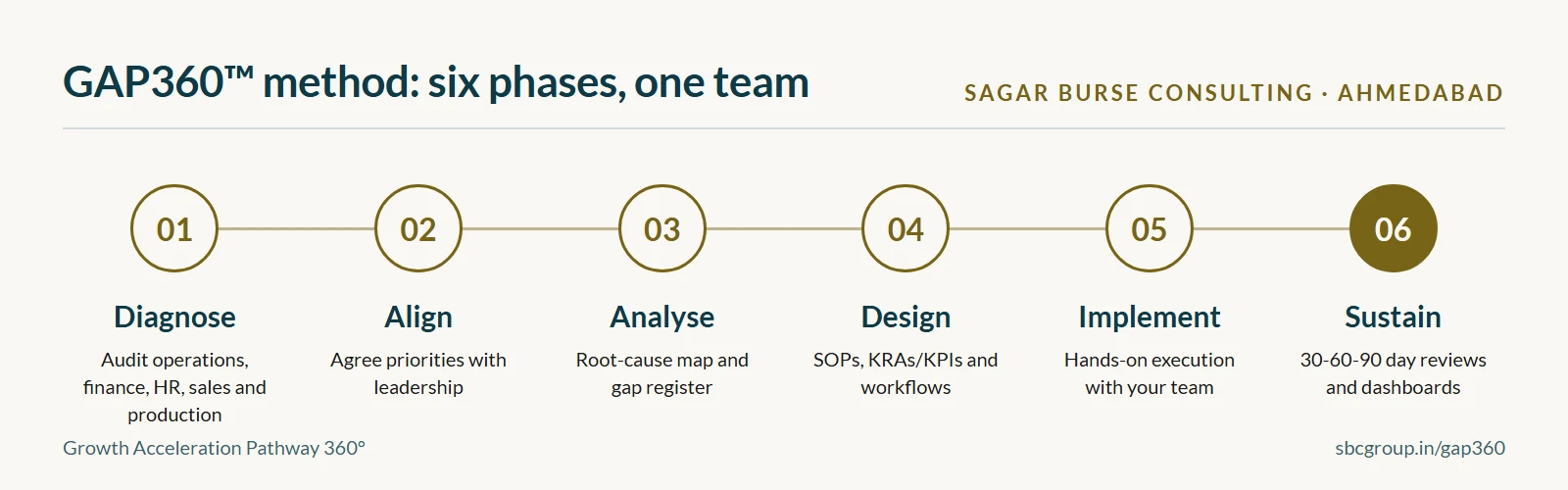
- 1.Diagnose. Audit operations, finance, HR, sales and production to find what is capping growth and estimate its rupee impact.
- 2.Align. Review findings with leadership so everyone agrees the priorities before anything is designed.
- 3.Analyse. Map the root cause of each constraint and rank them by impact.
- 4.Design. Build the growth roadmap, SOPs and KRA/KPI frameworks so your team can adopt them.
- 5.Implement. Work alongside your team, managing resistance and correcting course in real time.
- 6.Sustain. Run 30-60-90 day reviews and dashboards so growth continues after the engagement ends.
The full method is set out on our GAP360™ methodology page.
Business Growth Planning: Where to Start in the Next 30 Days
You do not need a consultant to begin. Business growth planning for an MSME can start small and still work, if it is built around one bottleneck at a time:
- Week 1: Pick one bottleneck. List what slowed growth most last quarter (missed deliveries, lost hires, a cash crunch) and choose the single biggest one.
- Week 2: Write the process down. On one page, capture who does what, in what order, and where hand-offs happen today.
- Week 3: Assign an owner and KPIs. Name one owner and two or three KPIs, such as on-time delivery percentage, lead-to-quote time or attrition.
- Week 4: Start the weekly review. Hold a 30-minute weekly check on those KPIs and fix the biggest gap first.
Then repeat with the next bottleneck. When the list outgrows what you can manage yourself, a structured diagnostic saves months. That is what our free 45-minute business systems audit is for.
Scaling Business Operations Without Losing Control
Scalable business growth means revenue can rise faster than the effort, cost and complexity needed to serve it. Sustainable business growth means those gains hold after a project ends or the founder's attention moves elsewhere. Business scalability is therefore mostly an operations question: can the same processes handle twice the orders?
Before scaling business operations, whether by adding headcount, a location or a product line, check that:
- Core processes are written down and followed by more than one person.
- Every function has a named owner and two or three KPIs.
- You can see cash, margin and receivables every week.
- New hires can become productive from documentation, not only by shadowing.
- The business runs for a week without you and nothing critical stalls.
- You know which single constraint you will hit next.
If you can tick fewer than four, fix systems before adding scale, because scale multiplies whatever is already there, including the weaknesses. If the next step is a new location or market, a feasibility study before capital is committed is worth the few weeks it takes.
What Systems-First Growth Looks Like in Practice
These are systems outcomes, not strategy documents. Each is published in full in our case studies:
- Rubber and plastics manufacturer: on-time delivery improved from 61% to 84%, with annual cost savings above ₹15 lakh in 90 days.
- Industrial components manufacturer: a 3-tier reporting structure with defined KRAs and KPIs freed 12 hours a week of the founder's time.
- Trading and distribution business: attrition fell from 34% to 18% and the hiring cycle from 45 to 22 days.
Browse all SBC case studies to see the starting problem, the systems built and the numbers for each.
How SBC Builds Business Growth Systems for MSMEs
SBC is an Ahmedabad-based consulting firm led by Sagar Burse, PhD. We work with founder-led MSMEs in manufacturing, trading, distribution and services, and with institutions and public bodies, across Gujarat and the rest of India. Every engagement starts with a GAP360™ diagnostic rather than a template, and we stay through implementation until the numbers move. Our business growth consulting services and MSME consulting are built around this systems-first approach.
If you are still comparing advisers, our management consultant hiring checklist sets out what to check before you hire.
Frequently Asked Questions
Tap a question to see the answer.
What are business growth systems?
Business growth systems are the documented processes, named owners, measurable KPIs and regular review routines that make growth repeatable. They let a business take on more orders, people and locations without depending on the founder to hold everything together.
Read: the 5 business systems every MSME must build before scaling →
What is a systems-first approach to business growth?
A systems-first approach starts by finding what is actually limiting growth today, then builds the processes, KPIs and review routines to remove that constraint before, or alongside, a growth strategy. The strategy then has a reliable engine to run on instead of depending on the founder's effort.
What is the difference between a business growth strategy and a business growth framework?
A business growth strategy decides where to grow: which markets, customers and products to pursue. A business growth framework is the structured sequence of steps used to turn that strategy into action, from diagnosis and prioritisation to design, implementation and review. SBC's framework is GAP360™.
What are the most common growth bottlenecks in a business?
The most common growth bottlenecks in MSMEs are founder dependency, undocumented processes, no reliable weekly numbers, hiring and attrition problems, inconsistent delivery, cash flow strain despite sales, and enquiries that are never tracked through to a closed order. The one that repeats every month is usually your real constraint.
How do I start business growth planning for my MSME?
Pick the single bottleneck that slowed you most last quarter, write down how that process works today, assign one owner and two or three KPIs, and hold a 30-minute weekly review. Repeat with the next bottleneck. A structured diagnostic helps once the list outgrows what you can manage internally.
How do I scale business operations without losing control?
Before adding headcount, locations or product lines, make sure core processes are written down and followed by more than one person, every function has a named owner and KPIs, you can see cash and margin weekly, and the business can run for a week without you. Scaling a weak system multiplies its problems.
What is the difference between scalable and sustainable business growth?
Scalable business growth means revenue can rise faster than the effort, cost and complexity needed to serve it. Sustainable business growth means those gains hold after a project ends or the founder's attention moves elsewhere. Business scalability comes down to whether documented systems and regular reviews can carry the extra load.
How long does it take to build business growth systems?
It depends on the constraint. A full GAP360™ diagnostic typically takes 2 to 4 weeks. SBC's published case studies range from a 60-day systems build to a 90-day delivery-improvement cycle and a six-month HR and growth-systems overhaul.
Do I need a business growth consultant to build these systems?
Not to start: an owner can begin with one bottleneck and a weekly review. A consultant helps when several bottlenecks compete, when the founder is too close to the work to see them, or when you need someone to stay through implementation so the systems are actually adopted.
Does SBC build business growth systems for MSMEs outside Ahmedabad?
Yes. SBC is headquartered in Ahmedabad, Gujarat, and works with MSMEs, institutions and government bodies across India. Diagnostics and strategy sessions can run remotely, with implementation support scoped to your location. The first step is a free 45-minute business systems audit.
Start With a Free 45-Minute Business Audit
No commitment. No jargon. Just clarity on where your business stands and what needs to change.
Book Your Free Audit