
MSME Growth
What Is Business Process Improvement? A Founder's Plain-English Guide
Dr. Sagar Burse · 28 September 2026
Ask most founders what is wrong with their business and they will point to people: someone is slow, someone made a mistake, someone did not follow up. Look closer and the same mistake keeps happening with different people. That is usually not a people problem. It is a process problem, and fixing it is what business process improvement is about.
This guide answers what is business process improvement in plain English, then walks through the steps, the methods, real examples and a simple way to start in your own business. It is written for founders and managers of MSMEs, not for process engineers, so there is no jargon you cannot use on Monday morning.
It is the practical companion to our guide to a business process improvement consultant: read that to understand what a consultant should do for you, and read this to understand the work itself.
The Short Answer
Business process improvement is finding how a piece of work really flows through your business, fixing the steps that are slow, error-prone or dependent on one person, and making the better way the standard through a written SOP, a named owner and a few KPIs. Do it one process at a time, measure before and after, and review it regularly so it keeps improving.
What Is Business Process Improvement?
A business process is any repeatable piece of work that turns an input into an output: an enquiry into an order, an order into a dispatch, a candidate into an employee, an invoice into cash. Business process improvement (BPI) is the deliberate effort to make one of those processes work better, meaning quicker, more accurate, cheaper or easier for the team to follow.
Three ideas sit at the heart of it. First, you improve a specific process, not “the business” in general. Second, you work from facts about how the work actually runs, not from how people think it runs. Third, the fix has to be written down and owned, otherwise the old habits return within weeks.
A useful test: if your best employee were on leave for a week, would the process still run the same way? If not, that process is a good candidate. It is the same pattern we describe in why most MSMEs stay stuck: the systems gap.
Signs Your Business Processes Need Improvement
You do not need a consultant to spot the symptoms. Look for these:
- Turnaround time keeps slipping, and nobody can say exactly where the time is lost.
- The same errors repeat despite reminders, because the process allows them.
- Results depend on who does the work, or which shift handles it.
- Knowledge lives in a few heads, so new hires take months to become productive.
- You cannot see status at a glance: is this order on track, stuck or already late?
Two or more of these repeating month after month is a strong sign that the process, not the people, needs attention.
Business Process Improvement vs Optimization vs Management: What's the Difference?
These terms are often used as if they mean the same thing. They do not, and knowing the difference helps you ask for the right help.
| Term | What it means | Example |
|---|---|---|
| Business process improvement | Fixing an existing process so it is faster, more accurate and less person-dependent | Redesigning order-to-dispatch so late orders stop |
| Business process optimization | Fine-tuning a process that already works to get more from the same effort | Cutting setup time on a machine that already runs well |
| Business process analysis | Mapping and measuring how a process runs today, before changing anything | A step-by-step map with owners and timings |
| Workflow improvement | Smoothing how tasks, approvals and handoffs move between people | One tracked request replacing chained WhatsApp approvals |
| Business process management (BPM) | The ongoing discipline of owning, monitoring and governing processes | Process owners, KPIs and a monthly review |
| Business process reengineering | Redesigning a process from scratch, usually a big change | Moving a manual order desk onto new software |
| Continuous process improvement | Small, regular improvements made as a habit, not a one-off project | Fixing the top three delay causes every month |
In short: improvement is the project that gets a process to a better state, and management is what keeps it there. A good engagement delivers both.
Business Process Improvement Steps: A 7-Step Method
Whatever method you prefer, good improvement projects follow the same sequence. These are the business process improvement steps we use with founder-led businesses:
- 1.Pick the process worth fixing. Choose the one that hurts most: the biggest rupee impact, the most customer complaints or the most firefighting. Do not start with five at once.
- 2.Map how it works today. Write every step as it really happens, with who does it and what they use. This is business process analysis, covered in the next section.
- 3.Measure a baseline. Record turnaround time, error or rework rate and cost before you change anything, or you will never know if the fix worked.
- 4.Find the root causes. Ask why at each delay or error until you reach the cause you can actually fix, not just the symptom.
- 5.Redesign the process. Remove steps that add nothing, combine or reorder others, fix handoffs and decide what, if anything, to automate.
- 6.Pilot it, document it and train the team. Test the new way on a small scale, write the SOP for how people will really use it and train everyone who touches the process.
- 7.Track KPIs and review. Compare against your baseline, hold a short weekly or monthly review and adjust. This is where continuous improvement begins.
Business Process Analysis: How to Map and Diagnose a Process
Business process analysis is where most improvements are won or lost. The rule is to walk the process itself, following one real order, hire or invoice from start to finish, rather than relying on the org chart or on what people say happens. For each step, capture:
- Owner: who does this step, and who hands it to them.
- Input and output: what arrives and what leaves, in what form.
- Working time versus waiting time: most delays hide in the waiting between steps, not in the work.
- Errors and rework: where things go back for correction, and how often.
- Tools used: registers, spreadsheets, software or messages, and where information is re-typed.
When the map is on one page, the problems are usually obvious: a step nobody owns, an approval that waits two days, the same data typed three times. That is also the moment to bring the team in, because the people doing the work know where it breaks.
Business Process Improvement Methods and Process Improvement Techniques
You will hear many names. Here is what each business process improvement method or technique is for, in plain terms:
- Lean: remove waste such as waiting, rework, unnecessary movement and overproduction. A good fit for almost any process.
- Six Sigma (DMAIC): a data-heavy routine of Define, Measure, Analyse, Improve and Control, best for high-volume, repeatable work where variation is costly.
- Kaizen: small improvements suggested and made continuously by the people doing the work.
- PDCA (Plan, Do, Check, Act): a simple loop for testing a change and keeping what works.
- Process mapping, SIPOC and value stream mapping: ways to draw the process so waste and handoffs become visible.
- 5 Whys and fishbone diagrams: ways to trace a problem back to its root cause.
- Checklists and mistake-proofing: making the wrong action hard or impossible at error-prone steps.
Which should an MSME use? For businesses with 25 to 60 people, the biggest early gains usually come from the basics: process mapping, root-cause analysis and clear SOPs. Add Lean thinking to cut waste, and use PDCA to keep improving. Heavier statistical methods are worth it only when volumes are high enough to justify the effort.
Business Process Improvement Examples
Here are common examples of business process improvement in a founder-led business. They are typical patterns, so your own numbers will differ:
- Order-to-dispatch. Orders passed on verbally become one order sheet with clear status stages and a short daily dispatch check. Measure on-time delivery.
- Quotation follow-up. Quotes that were sent and forgotten become a simple pipeline with a follow-up date on every quote. Measure days to follow up and quote-to-order conversion.
- Hiring and onboarding. Ad-hoc hiring becomes a standard job brief, an interview scorecard and a 30-day onboarding checklist. Measure time to hire and early attrition.
- Invoicing and collections. Late invoices become invoicing at dispatch, plus a weekly receivables review with a named owner. Measure days taken to collect.
- Purchase and stock. Reordering by memory becomes minimum and maximum stock levels checked weekly. Measure stock-outs and rush-order costs.
- Customer complaints. Complaints handled by phone become a log with an owner, a closing deadline and a weekly review of repeat causes. Measure repeat complaints.
Real results look like this. These are outcomes from SBC engagements, published in full in our case studies:
- Rubber and plastics manufacturer: a process audit and redesigned delivery workflow lifted on-time delivery from 61% to 84%, with annual cost savings above ₹15 lakh from a 90-day engagement.
- Industrial components manufacturer: a 3-tier reporting process with defined KRAs and KPIs freed 12 hours a week that used to go into chasing information.
- Trading and distribution business: a redesigned hiring and onboarding process cut the hiring cycle from 45 to 22 days and attrition from 34% to 18%.
How to Improve Business Processes: 8 Quick Workflow Improvement Wins
Before any big project, these eight moves improve most processes. They are also the cheapest form of business process optimization:
- 1.Write the process on one page. If it cannot fit on a page, it is too complicated to run consistently.
- 2.Remove steps that add no value. Question every approval, copy and report: who uses it, and what happens if we stop?
- 3.Give every step an owner and a due time. Handoffs without a name and a deadline are where work waits.
- 4.Standardise inputs. One form or template for each request removes back-and-forth clarification.
- 5.Add a checklist where errors happen. Use it at the two or three steps that produce most of your rework.
- 6.Make status visible. A simple board or tracker everyone can see beats asking around.
- 7.Do waiting tasks in parallel. If two checks do not depend on each other, run them at the same time.
- 8.Automate last. Simplify first. Automating a broken process only makes the mistakes faster.
Continuous Process Improvement: Making the Fix Stick
Continuous process improvement is what separates a fix that lasts from one that fades after three months. The routine is simple: one named process owner, two or three KPIs on a visible dashboard, a short weekly check, and a monthly review of the top three causes of delay or rework, each with a fix and an updated SOP. Keep the loop going with PDCA: plan a change, try it, check the numbers, then keep or drop it.
Watch for the five mistakes that make improvement fail:
- Fixing too many processes at once, so none of them gets finished.
- Redesigning before mapping and measuring, so the real cause is missed.
- Writing SOPs that nobody uses because the team was never consulted.
- Having no owner and no KPI, so nobody notices when it slips back.
- Treating improvement as a one-off project instead of a habit.
If you do this across the business, you are building what we call business growth systems: the documented processes, owners and reviews that let a company grow without the founder holding everything together. For the SOP side, see the five business systems every MSME must build before scaling.
How SBC Approaches Business Process Improvement for MSMEs
SBC is an Ahmedabad-based consulting firm led by Sagar Burse, PhD. We work with founder-led MSMEs in manufacturing, trading, distribution and services, and with institutions and public bodies, across Gujarat and the rest of India. Our method, GAP360™, takes every process through six stages: Diagnose, Align, Analyse, Design, Implement and Sustain, and we stay through rollout and training until the numbers move.
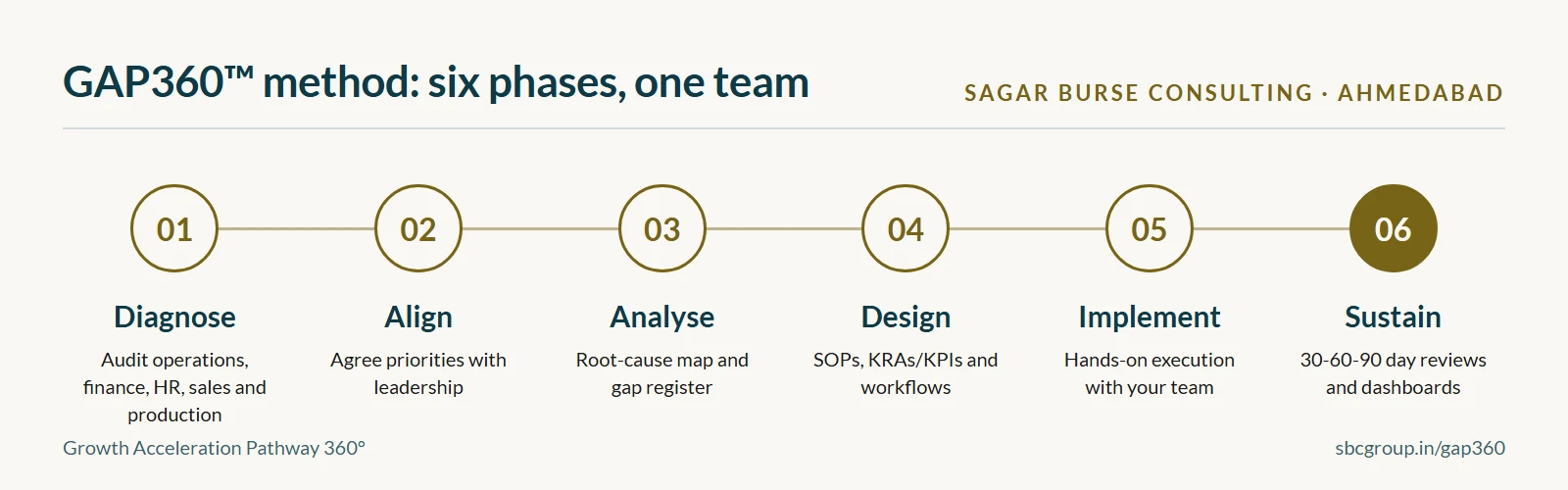
See our business process improvement services and MSME consulting for how this works in practice, or read the full GAP360™ methodology. If you are still comparing advisers, our management consultant hiring checklist sets out what to check before you hire.
In This Article
- What is business process improvement?
- Signs your processes need work
- Improvement vs optimization vs BPM
- Business process improvement steps
- Business process analysis
- Methods and techniques
- Business process improvement examples
- How to improve business processes
- Continuous process improvement
- How SBC approaches it
- FAQ
Frequently Asked Questions
Tap a question to see the answer.
What is business process improvement?
Business process improvement is the practice of studying how a piece of work really flows through your business, such as order-to-dispatch, hiring or invoicing, and redesigning it so it is faster, more accurate and less dependent on any one person. The new way is then documented and tracked so it sticks.
Read: business process improvement consultant, the complete guide →
What are the steps of business process improvement?
A practical seven-step sequence is: pick the process worth fixing, map how it works today, measure a baseline, find the root causes, redesign the process, pilot it with a written SOP and training, then track KPIs and review regularly. Skipping the mapping and measuring steps is the most common reason improvements fail.
What are the main business process improvement methods and process improvement techniques?
The best-known methods are Lean, Six Sigma (DMAIC), Kaizen and the PDCA cycle. Common techniques include process mapping, SIPOC, value stream mapping, the 5 Whys, checklists and mistake-proofing. Most founder-led MSMEs get the biggest early gains from simple mapping, root-cause analysis and clear SOPs before adopting heavier methods.
How do I improve business processes in a small business?
Start with one process that hurts most, write down how it works today on a single page, name one owner, choose two or three KPIs such as turnaround time or rework rate, remove steps that add no value, and review the numbers weekly. Repeat with the next process once the first one holds.
What is the difference between business process improvement and business process optimization?
Business process improvement fixes a process that is slow, error-prone or person-dependent. Business process optimization fine-tunes a process that already works to get more output from the same effort, for example lower cost or shorter cycle time. In practice the two overlap, and improvement usually comes first.
What is business process analysis?
Business process analysis is the study step of improvement. You map every step of a process as it actually runs today and record who does it, how long it takes, how long work waits, and where errors and rework happen. The map shows where time and quality are being lost, so you fix the right thing.
What is workflow improvement?
Workflow improvement focuses on how tasks, approvals and handoffs move between people or systems. Typical fixes include removing unnecessary approvals, giving each step a named owner and a due time, using one tracked request instead of scattered messages, and making status visible to everyone.
What is continuous process improvement?
Continuous process improvement means making small, regular improvements as a habit instead of running one big project. A simple routine is a monthly review of the top three causes of delay or rework, a fix for each, and an updated SOP. It is what keeps a fixed process from drifting back.
Can you give examples of business process improvement?
Common examples include a single order sheet with status stages and a daily dispatch check, a quotation pipeline with follow-up dates, a hiring scorecard and onboarding checklist, invoicing on dispatch with a weekly receivables review, and a complaint log with an owner and a closing deadline. SBC's published case studies show real numbers for several of these.
When should I hire a business process improvement consultant?
Consider one when several processes are failing at once, when the founder is too close to the work to see the causes, or when earlier fixes did not last. SBC is based in Ahmedabad, Gujarat, and works with MSMEs across India, staying through implementation. The first step is a free 45-minute business systems audit.
Start With a Free 45-Minute Business Audit
No commitment. No jargon. Just clarity on where your business stands and what needs to change.
Book Your Free Audit